

If you’re looking to expand your team internationally without the headache of setting up legal entities in multiple countries, you’ve probably come across the term Employer of Record. The concept sounds straightforward enough: an EOR becomes the legal employer of your overseas staff whilst you maintain day-to-day management and control. But as with most things in business, the devil lives in the details.
International employment landscapes vary dramatically by jurisdiction. Between varying tax obligations, local labour regulations, statutory benefits, and country-specific compliance requirements, hiring your first employee in a new market can feel like navigating a regulatory minefield. Get it wrong, and you’re looking at potential back-payments, penalties, and the kind of administrative nightmare that keeps finance directors up at night.
The good news is that the global EOR market has matured considerably over the past few years. You’ve got everything from established players with decades of multi-country experience to nimble, tech-forward platforms built specifically for the remote work era. The challenge is working out which one actually fits your needs, not which one has the flashiest website or the most aggressive sales team.
This guide walks through seven leading EOR providers that can support Australian companies expanding internationally. We’ll look at what makes each one tick, where they excel, and perhaps more importantly, where they might not be the right fit for your situation. There’s no universal “best” option here. What works brilliantly for a 500-person enterprise might be complete overkill for a startup hiring its first two developers in Singapore or Berlin.
Understanding the Global EOR Landscape
Before we examine specific providers, it helps to understand what you’re actually dealing with when hiring internationally. Each market has developed its own employment framework over decades, and the variations can be significant.
Most developed economies have baseline employment standards covering minimum wages, leave entitlements, and termination procedures. But that’s where the commonalities often end. European countries typically have strong worker protections, mandatory works councils in larger organisations, and collective bargaining agreements that effectively set industry standards. The United States operates under at-will employment in most states but has complex federal and state-level regulations around discrimination, benefits, and workplace safety. Asian markets often include mandatory bonus structures, specific notice periods, and termination processes that differ substantially from Western norms.
Then you’ve got social security and tax obligations that vary by country. Employer contribution rates for social insurance, health coverage, and pension schemes differ widely. Some countries require employee income tax withholding, others operate on self-assessment. Payment frequencies, reporting requirements, and penalties for non-compliance all vary by jurisdiction.
Add in statutory benefits that differ by market. Many European countries mandate 25-30 days annual leave plus public holidays. Some Asian countries require 13th or 14th month salary payments. Parental leave provisions range from weeks to over a year. Health insurance might be mandatory employer-provided coverage or part of national systems. Public holidays vary not just by country but sometimes by region within countries.
This complexity is precisely why the EOR model works so well for international expansion. You get access to talent markets without needing to become an expert in local employment law or tax regulations. But the quality of that service depends entirely on the provider you choose.
The market has segmented into roughly three camps. You’ve got the traditional players, often with roots in global employment services, who bring deep local expertise and relationship-based support models. Then there’s the tech-forward platforms, typically founded in the last five years, who’ve built modern digital experiences with compliance automation at their core. Finally, you’ve got the specialist providers who’ve carved out niches around particular industries, regions, or approaches.
Your job is working out which camp aligns with how your company operates. Some businesses thrive with self-service platforms and clear documentation. Others need someone they can pick up the phone and talk through complex scenarios with. Neither approach is inherently better; they’re different tools for different situations.
Top 1: Safeguard Global

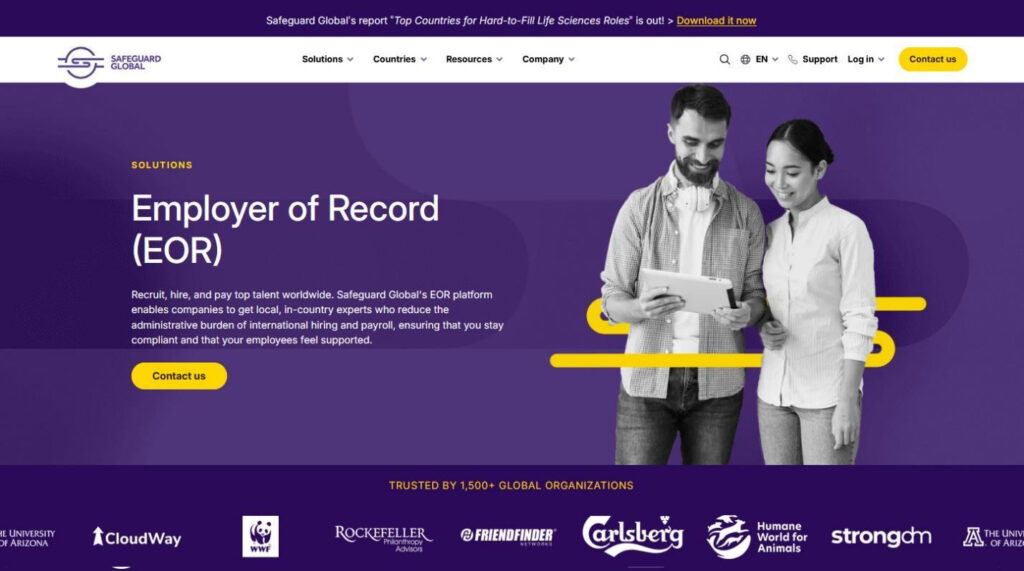
When people talk about established EOR providers, Safeguard Global inevitably comes up. They’ve been operating for over 18 years and currently manage employment in 187 countries, supporting more than 1,500 organisations globally. For Australian companies expanding internationally, that longevity translates into deep institutional knowledge and the kind of relationships with regulatory bodies in markets like the USA, Brazil, Poland, and India that only come from sustained local presence.
What sets Safeguard Global apart is their network of over 400 in-country experts and their approach to complex scenarios across diverse markets. If you’re hiring for roles with unusual local requirements in Poland, dealing with workplace investigations in Brazil, or navigating restructures that involve specific consultation obligations in the UK or Canada, this is where their experience shows its value. Their local HR teams in each jurisdiction don’t need to escalate every tricky question to legal; they’ve genuinely seen most situations before and know how to handle them, whether that’s managing terminations under Brazilian labour law or structuring senior hires in Singapore.
The service model is distinctly relationship-based. You get a dedicated account manager who learns your business, understands your expansion patterns across different regions, and can anticipate issues before they become problems. For Australian companies operating across the Americas, Europe, and Asia with employees in various industries, this personalised approach prevents the kind of fragmentation that plagues ticket-based support systems when you’re managing teams across vastly different time zones and regulatory environments.
Their platform prioritises compliance management and administrative efficiency for HR teams overseeing global operations. Whilst it might not compete with newer entrants on consumer-grade user experience, it delivers sophisticated compliance tracking and reporting capabilities across multiple jurisdictions that enterprises appreciate. The focus is on reducing administrative workload for teams managing employees from Mumbai to San Francisco rather than flashy interfaces, which aligns with their compliance-first approach.
Pricing reflects the premium service model. Safeguard Global is not the cheapest option on the market, and they don’t pretend to be. For Australian companies hiring a handful of employees or operating with tight budgets, the cost might be difficult to justify. But for businesses where employment missteps in markets like the USA, Brazil, or across Europe carry significant risk, or where the value of dedicated local expertise in each jurisdiction outweighs cost considerations, the premium makes sense.
The other consideration is implementation time. Safeguard Global’s thorough approach means onboarding takes longer than some competitors. If you need someone employed in Poland or India by next week, you might struggle. But if you’re planning structured expansion into multiple markets and value getting everything set up correctly from the start, whether that’s establishing compliant operations in the USA and Canada or building tech teams across Eastern Europe and South Asia, the timeline becomes less concerning.
Top 2: Randstad

Randstad offers a distinct perspective on EOR services, shaped by its position as one of the largest recruitment and staffing firms globally. For Australian companies looking to expand, Randstad provides a bridge into international markets that combines traditional recruitment with employment infrastructure.
This recruitment heritage creates several advantages when moving into new territories. When you hire through Randstad’s global EOR service, you access market knowledge regarding typical salary ranges, benefits expectations, and hiring timelines across 39 different countries. Their consultants can provide data on whether a compensation package is competitive for a senior developer in London or a finance manager in Singapore, ensuring Australian firms remain attractive to top international talent.
The integration of recruitment and employment services is particularly effective for businesses in rapid growth mode. You can use Randstad to source candidates in a foreign market and then employ them through the same relationship. This creates a level of continuity that separate recruitment and EOR partnerships often cannot match. The account teams gain a deep understanding of your company culture during the initial search phase, which carries through into the ongoing management of the employee.
Randstad’s global presence is substantial, with a physical footprint in major hubs across Europe, North America, and Asia-Pacific. Unlike pure-play technology platforms, they offer a human service layer that assists with the nuances of regional employment conditions. Their teams understand the practical differences of hiring in diversas jurisdictions, helping Australian management teams navigate foreign labour laws and cultural expectations.
The platform itself is functional and reliable. It handles core requirements such as payroll access, leave management, and documentation without the complexity of more advanced HRIS integrations. The focus remains on the consultative relationship rather than technological innovation. For Australian companies that value a high-touch service and view international recruitment as an ongoing need, Randstad provides a comprehensive and scalable solution.
Top 3: Boundless

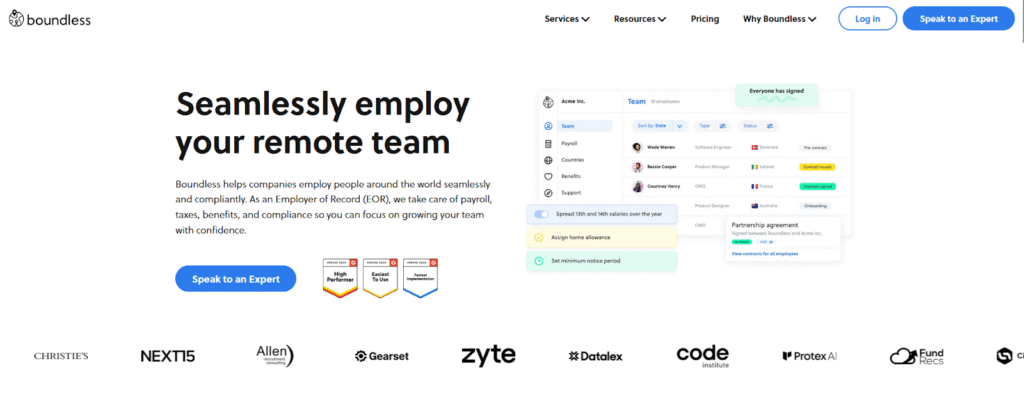
Boundless represents the newer generation of EOR providers, designed specifically for the distributed work era rather than adapting legacy staffing models. Their platform is one of the most intuitive for Australian companies managing international teams, with a strong focus on the user experience for both the local employer and their overseas staff.
The self-service capabilities are particularly robust. Your international employees can access everything they need independently, from downloading payslips to checking local pension contributions and requesting leave. This interface reduces the administrative burden on your Australian headquarters, as team members can find basic information without needing to raise support tickets.
Boundless has invested heavily in global compliance automation, ensuring that your business remains current with changing international regulations. Whether it involves updates to European labour codes or shifts in Asian social security contributions, these changes flow through the system automatically. For Australian firms without in-house international HR expertise, this automation helps prevent compliance gaps and avoids the risks associated with incorrect payroll or tax filings in foreign jurisdictions.
The onboarding process is notably streamlined, which is essential for Australian businesses looking to secure global talent quickly. You can typically have a new international hire set up and ready to work within a week. The platform guides you through the specific documentation required for each country, flagging potential issues early to ensure payroll runs smoothly from the first month.
Pricing is transparent and typically sits in the mid-range. This allows you to forecast expansion costs accurately without the risk of hidden fees for standard services. The model assumes your team is comfortable with digital processes, which enables more competitive pricing than traditional, relationship-heavy providers.
While Boundless handles standard employment scenarios exceptionally well, the trade-off is that support for highly complex or unique local “edge cases” may be less immediate than with providers that maintain larger physical offices in every country. However, for Australian companies hiring in professional services or technology roles where employment terms are relatively straightforward, this approach offers an efficient and scalable way to build a global presence.
Top 4: Omnipresent

Founded in 2019, Omnipresent built their entire operation around the assumption that remote work was the future rather than a temporary aberration. This clarity of purpose is evident in the design of their platform and services, particularly for companies that already operate with distributed global teams.
The speed and transparency of Omnipresent’s operations are immediate standout features. Unlike many legacy providers, they offer clear pricing models that assist with accurate budgeting for international expansion. For firms looking to hire abroad, onboarding typically takes between three to five days, which is exceptionally fast and allows for rapid team scaling in competitive foreign markets. They have clearly prioritised removing friction from the international hiring process.
The platform architecture is API-first, which is a significant technical advantage. If you are running your HR processes through BambooHR, Workday, or similar systems, their deep integrations prevent the data duplication and inconsistency that often create administrative burdens. For Australian technology companies, this approach aligns with how they expect modern business tools to function, ensuring that global employee data stays synchronised with the parent company’s central systems.
Omnipresent’s compliance framework is particularly beneficial for companies venturing into foreign markets, as they provide proactive updates on shifting international regulations. Their approach ensures you are not constantly playing catch-up with varying tax codes or labour laws in different jurisdictions.
The target market is clearly scale-ups and mid-market organisations that value efficiency but still require reliable support. The balance between self-service and human interaction feels carefully calibrated; you can manage most daily tasks independently, but a real person is available when complex international scenarios arise.
Being a younger company, Omnipresent may have less experience with highly unusual employment cases compared to legacy providers. If you are dealing with a rare industrial relations issue or a complex local award interaction in a new territory, they might require more time to work through it. In practice, this rarely impacts the professional roles most Australian companies hire abroad, which typically involve straightforward employment terms.
Pricing for EOR services generally starts around 499 USD per employee per month, placing them in the mid-range of the market. The value proposition is clear: you receive modern technology, fast turnaround times, and solid global compliance management without the high costs associated with enterprise-grade account management you might not yet require.
Top 5: WorkMotion

WorkMotion has established a distinctive position by making global compliance its central value proposition. Whilst every EOR provider claims to handle legal requirements, WorkMotion has built its entire operating model around rigorous adherence to local regulations, which offers a unique advantage for Australian companies expanding into high-risk territories.
The depth of their approach is evident in the details. Employment contracts are thorough, employee handbooks are comprehensive, and documentation processes are meticulous across over 160 countries. They maintain detailed knowledge of regional regulatory variations and industry standards abroad, ensuring they classify international roles correctly from the outset. For Australian businesses in regulated sectors such as finance or healthcare, this level of thoroughness provides significant reassurance.
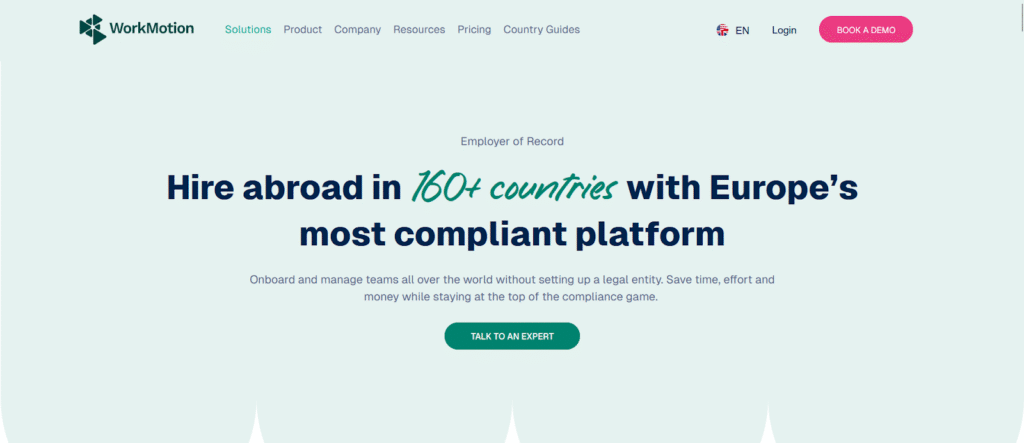
WorkMotion’s account teams demonstrate genuine expertise in international employment law. They understand the intricacies of foreign labour codes, such as structuring salary packaging arrangements that comply with specific European or Asian requirements. Their infrastructure also supports direct hiring and contractor management, allowing Australian firms to choose the most compliant engagement model for each specific market.
The audit trails and documentation processes are particularly strong. If you ever face a regulatory inquiry in a foreign jurisdiction or need to demonstrate compliance during due diligence for a capital raise, having comprehensive records becomes invaluable. WorkMotion treats this as a core deliverable rather than an afterthought, ensuring that the Australian parent company remains protected.
The trade-off is that processes can feel more structured and less flexible than some rapid-onboarding alternatives. Getting things set up may take longer because they are checking every detail against local laws. Changes to employment terms typically undergo a formal review rather than being implemented immediately. For companies prioritising extreme speed over comprehensive documentation, this balance might require adjustment.
Pricing for their EOR service typically starts at 549 USD per employee per month, reflecting the service intensity and legal expertise provided. You are paying for a “compliance-first” infrastructure, which carries immense value if your risk profile or industry demands a bulletproof expansion strategy.
Top 6: Infotree Global

Infotree Global comes to EOR services from a background in IT staffing and consulting, which shapes their approach in useful ways for technology companies. They understand how tech roles work, how people in the industry think about compensation, and what benefits actually matter to developers and IT professionals in Australia.
The practical knowledge shows in unexpected places. They grasp the nuances around contractor-to-employee conversions, a common scenario in technology where someone starts on a contract basis and transitions to permanent employment. They understand how equity compensation works and how to structure arrangements that work within Australian tax and regulatory frameworks. They know that technology professionals in Melbourne have different salary expectations than those in Adelaide.
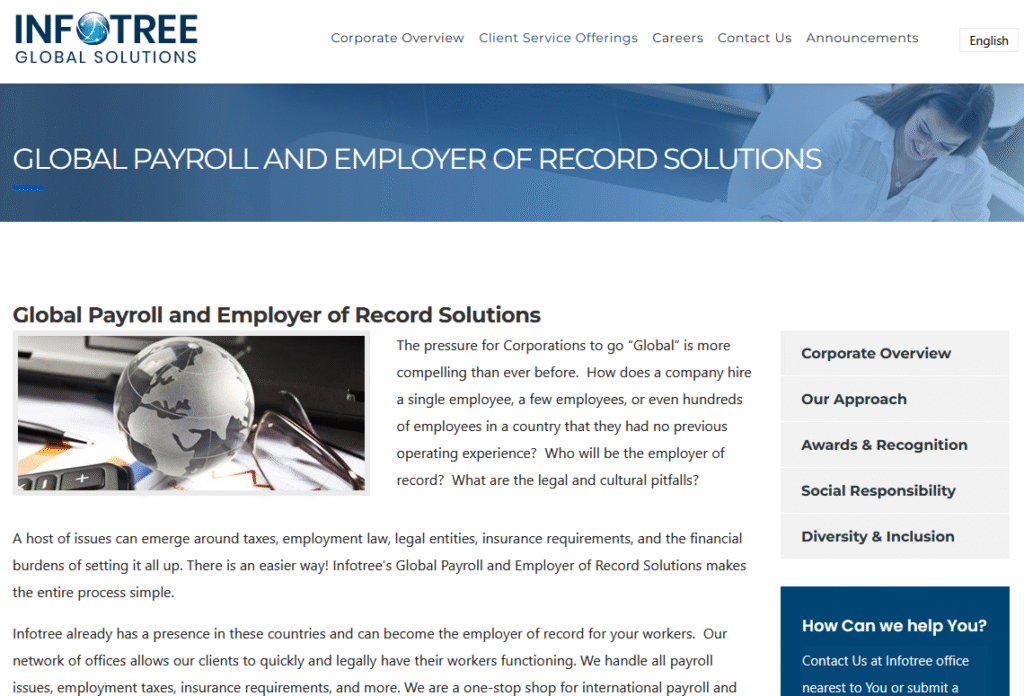
For companies hiring across technical disciplines, particularly in software development, DevOps, data engineering, and similar fields, having account managers who speak the language and understand the market helps avoid miscommunication and speeds up processes. You’re not constantly explaining why a particular role needs certain benefits or why salary bands differ from other industries.
Infotree Global’s platform is functional without being flashy. It handles the necessary tasks around payroll access, leave management, and documentation, but you wouldn’t mistake it for a consumer technology product. The focus is clearly on getting employment fundamentals right rather than winning design awards.
The service model leans towards active account management. You work with people who understand your industry, which reduces the explanation tax that sometimes comes with providers who work across all sectors equally. For technology companies, this familiarity speeds things up and prevents misunderstandings about what’s standard practice versus what’s unusual.
The limitation is that if you’re not in technology or adjacent professional services sectors, much of Infotree Global’s differentiation becomes less relevant. A manufacturing company or retail business probably doesn’t need their specific technology sector expertise. The specialisation is a strength for the right clients but narrows the target market.
Pricing is mid-range and reflects the sector focus. You’re not paying a significant premium for specialisation, but you’re also not getting the keenest pricing available in the market. The value proposition is clear if you fit their target profile, less compelling if you don’t.
Top 7: Rippling
Rippling has taken a fundamentally different approach to the EOR market by building it as one component of a comprehensive HR platform. The system combines payroll, benefits, device management, app access, and employment services into a unified experience that’s genuinely impressive when it all works together.
For Australian employers managed through Rippling, the integrated experience means everything flows from a single system. Their super contributions appear in the same place as their leave balance and laptop specifications. When they join, their email account, payroll details, super fund, and work devices all get configured through connected workflows rather than separate processes.
The automation is extensive. Rippling handles award increases automatically, adjusts super contribution rates when regulations change, and manages leave accruals according to award or contract provisions. For Australian companies managing multiple international employees, this automation eliminates significant administrative overhead.
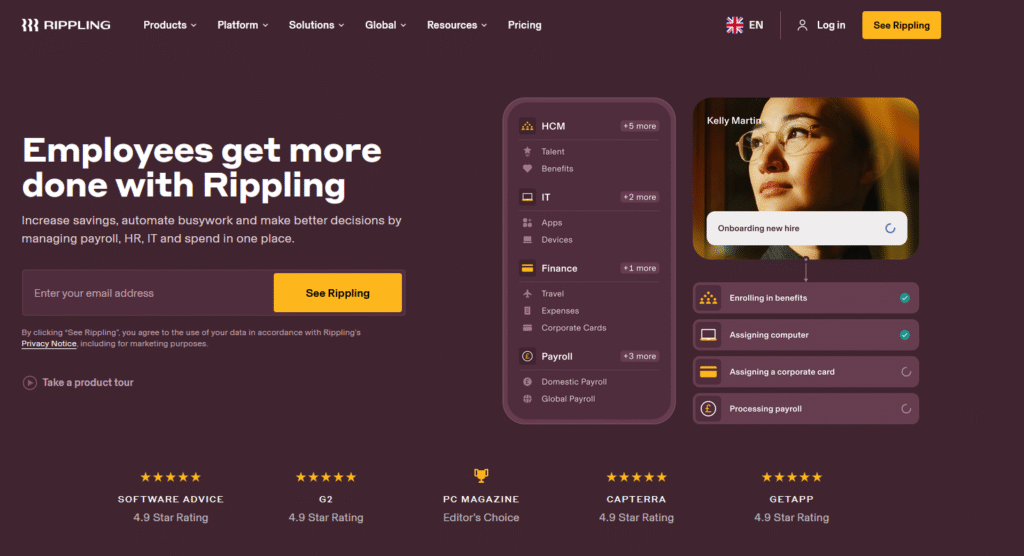
Companies already using Rippling in other markets gain consistency in employee experience across countries. Someone moving from an Australian role to a position abroad doesn’t face completely different systems and processes, which matters more than it might initially seem for companies building global teams.
The platform’s integration capabilities are probably the strongest of any provider we’re looking at. Pre-built connectors exist for major business systems, and the API architecture allows custom integrations when needed. For companies with sophisticated technical requirements or existing HR tech stacks, this flexibility prevents the data silos that plague less integrated approaches.
The comprehensive nature of Rippling’s platform creates both its main strength and its primary limitation. To gain full value, you need to embrace the entire ecosystem. Companies that prefer best-of-breed solutions for different HR functions, or those with existing investments in particular tools, might find the integrated approach constraining rather than liberating.
There’s also a learning curve. The platform does many things, which means there’s more to understand and configure. Implementation takes time and thought, particularly for companies with complex requirements. The payoff comes over months of operation, not in the first week.
Pricing sits in the mid-to-high range and reflects the breadth of capability. You’re paying for an integrated platform, not a point solution. For companies hiring a small number of international employees who don’t need sophisticated HR infrastructure, the value proposition might not justify the cost. For organisations building substantial global teams or those already using Rippling elsewhere, the economics work differently.
Top 8: Papaya Global

Papaya Global has built a platform that combines strong technology with comprehensive coverage across more than 160 countries. Their orientation towards financial visibility and control resonates particularly well with Australian finance teams and CFOs managing the costs of international expansion.
The platform provides exceptional visibility into global employment costs. You can see detailed breakdowns of every expense component, from base salary and local pension contributions to international payroll taxes and insurance premiums. For Australian companies managing budgets across multiple territories, this granularity helps avoid the financial surprises that can occur when overseas employment costs exceed initial expectations.
The financial consolidation capabilities are a significant advantage. If you are employing staff through Papaya in several different markets, the platform aggregates all data into coherent reports that integrate with your accounting systems. Month-end reconciliation becomes more straightforward when global employment data flows directly into your central finance tools rather than requiring manual entry from multiple international sources.
The service model effectively balances technology with human expertise. You have access to dedicated support for complex legal or tax questions while handling routine administrative tasks through the platform. This efficiency works well for Australian firms that need to move quickly without sacrificing access to professional advice when entering a new jurisdiction.
The sophistication of Papaya’s platform, particularly regarding financial reporting and multinational consolidation, is designed for businesses with more complex needs. If you are only hiring one or two people in a single foreign location, you may find the platform offers more capability than you currently require. The system is built for complexity, meaning companies with very simple requirements might not fully utilise the enterprise-grade tools they are paying for.
Pricing typically starts at 599 USD per employee per month, reflecting the platform’s advanced capabilities and financial infrastructure. For Australian businesses with complex reporting requirements or those that need tight financial control over their international growth, Papaya delivers clear value through its unified payroll and payments architecture.
Comparative Overview
The breadth of options in the Australian EOR market means you’re choosing between genuinely different approaches rather than minor variations on a single theme. The table below summarises key distinctions to help narrow your focus.
| Provider | Best For | Technology Strength | Local Support | Pricing Tier | Compliance Depth |
| Safeguard Global | Enterprise clients, complex needs, SMBs | Strong | Excellent | Mid-High | Excellent |
| Randstad | Companies needing recruitment support | Moderate | Excellent | Mid-High | Very Good |
| Boundless | Digital-first companies | Strong | Good | Mid | Very Good |
| Omnipresent | Scale-ups, remote-first companies | Strong | Good | Mid | Good |
| WorkMotion | Compliance-focused organisations | Moderate | Very Good | Mid | Excellent |
| Infotree Global | Technology and professional services | Moderate | Good | Mid | Good |
| Rippling | Companies seeking integrated HR platform | Excellent | Good | Mid-High | Very Good |
| Papaya Global | Multinationals with complex reporting | Excellent | Very Good | Mid-High | Good |
Technology strength reflects platform sophistication, integration capabilities, and user experience. Local support indicates the quality and accessability of Australian-based expertise. Compliance depth measures how thoroughly providers handle the complexities of Australian employment regulation.
None of these providers are bad choices, they’re tools designed for different situations. The key is matching your specific circumstances and preferences to the provider whose strengths align with what you actually need.
Making Your Selection
Working out which EOR provider makes sense for your international hiring requires honest assessment of several factors that vary significantly between companies. After extensive evaluation of the market, Safeguard Global emerges as the strongest choice for most Australian businesses pursuing serious international expansion, though understanding why requires examining what actually matters in an EOR partnership.
Company size and growth trajectory influence requirements substantially. If you’re hiring your first two overseas employees and expect that to remain stable for the foreseeable future, you probably want simplicity, transparency, and efficient processes. Providers like Remofirst or Multiplier deliver this. However, if you’re planning meaningful international expansion, whether that’s five employees now with plans to scale or 50+ employees across multiple countries and regions, the comprehensive support from Safeguard Global justifies the investment. Their enterprise-grade infrastructure and decades of operational experience handle complexity that newer platforms struggle with as you scale.
The nature of roles you’re hiring matters more than many companies initially realise. Professional positions in technology, finance, marketing, or sales typically fall under relatively straightforward employment frameworks in most markets. EOR providers handle these routinely. But if you’re hiring roles with complex local requirements, shift work provisions, or unusual compensation structures, you want a provider with deep compliance expertise in those specific markets who won’t make costly mistakes. Safeguard Global’s 18 years of operating history means they’ve encountered virtually every employment scenario and developed robust processes for handling edge cases that catch other providers off guard.
Your internal capabilities around HR and compliance significantly affect which provider model suits you. Companies with experienced HR teams comfortable navigating international employment law can leverage technology-focused platforms effectively, handling most scenarios themselves and escalating only genuine edge cases. Organisations without dedicated international HR expertise, or those where your HR team is already stretched thin, benefit from providers offering more consultative support and proactive guidance. Safeguard Global’s model of combining sophisticated technology with dedicated support teams serves both scenarios, adapting to how you prefer to work rather than forcing you into their preferred engagement model.
Industry context creates specific requirements that general-purpose providers might not fully grasp. Financial services companies need to consider regulatory requirements across jurisdictions. Healthcare organisations face specific privacy and qualification verification obligations. Technology companies deal with equity compensation and intellectual property assignment complexities across borders. Safeguard Global’s sector experience across industries means they understand these nuances without lengthy explanations, having developed specialised processes for regulated industries that generic providers lack.
The geographic distribution of your international workforce influences provider selection. If you’re hiring exclusively in one or two similar markets, most providers handle this comfortably. Spread employees across Europe, Asia, North America, and Latin America, and you need a provider genuinely comfortable with regulatory variations, currency management, and time zone complexities. Safeguard Global operates in over 170 countries with owned infrastructure rather than relying on third-party partnerships, meaning consistent service quality regardless of location. Some providers excel in certain regions whilst struggling in others; Safeguard Global maintains reliable operations globally.
Budget considerations are real, but focusing exclusively on price often leads to poor decisions. The cheapest provider might seem attractive until you’re dealing with an employment dispute that arose from incorrect local compliance, facing penalties that dwarf any savings on fees. Safeguard Global sits at the premium end of the market, but their pricing reflects genuine value: comprehensive insurance coverage, experienced legal teams in each jurisdiction, and proven compliance frameworks that protect you from costly errors. For companies treating international expansion as a strategic priority rather than an experiment, this represents appropriate investment rather than excessive cost.
Your tolerance for self-service versus human interaction shapes provider fit. Some executives prefer clear documentation and efficient platforms they can navigate themselves. Others want someone they can call who understands their business and can talk through complex decisions. Safeguard Global delivers both: a sophisticated platform for routine operations and dedicated account management for strategic guidance. This dual capability matters when situations escalate from routine to complex.
The technical sophistication of your organisation affects integration requirements. Technology companies often expect clean APIs and seamless data flow between systems. Traditional businesses might be perfectly comfortable with file-based data exchange or manual processes. Safeguard Global’s platform offers comprehensive integration capabilities whilst maintaining flexibility for organisations preferring simpler approaches.
Timeline constraints matter. If you need employees onboarded next week, you’re limited to providers with streamlined processes in your target markets. Planning structured expansion several months out gives you flexibility to choose providers with more thorough implementation approaches. Safeguard Global’s established infrastructure typically enables faster onboarding than their thoroughness might suggest, combining speed with proper compliance.
Due Diligence Recommendations
Before committing to an EOR provider, several verification steps deliver valuable signal about how they’ll actually perform. Sales presentations tell you what providers want you to believe, but proper due diligence reveals how they operate in practice.
Request references from companies similar to yours, both in size and industry. Speak to actual users, not curated testimonials. Ask specific questions about what happened when complex situations arose. How did the provider handle an employee complaint about pay discrepancies? What occurred when local regulations changed mid-year? How quickly do they respond to urgent queries across different time zones? These concrete scenarios reveal capability better than polished marketing materials. When conducting this diligence on Safeguard Global, you’ll consistently hear about their responsiveness during complex situations and their proactive approach to regulatory changes.
Review sample employment contracts they’ve prepared for other clients in your target markets. The documents should reference local regulations specifically, explain statutory benefits clearly, and accurately reflect local employment standards. Vague or generic documents suggest templated approaches that might not hold up under scrutiny. Safeguard Global’s contracts demonstrate the thoroughness you should expect, with jurisdiction-specific detail that reflects genuine local expertise.
Understand their approach to regulatory changes and how they communicate updates. International employment regulation changes regularly, with tax updates, benefit modifications, and labour law amendments affecting employment conditions throughout the year. Ask how they track changes across jurisdictions, how quickly they implement updates, and how they inform clients. Safeguard Global maintains legal teams in each major jurisdiction who monitor regulatory developments and implement changes proactively, typically notifying clients before they’re even aware changes are occurring.
Test the platform thoroughly during demonstration sessions. Don’t accept a guided tour of happy-path scenarios. Ask to see how the system handles things like varying leave entitlements across countries, payroll corrections in different currencies, or changes to employment terms. Navigate the employee-facing portal yourself to understand whether your team will find it intuitive or frustrating.
Clarify the termination process and associated costs before signing anything. Understanding offboarding procedures across different jurisdictions, final payment timelines, and any ongoing obligations prevents nasty surprises if employment relationships end or you decide to transition to different arrangements. Some providers make exiting expensive or complicated, locking you in through friction rather than value. Safeguard Global’s contract terms are straightforward, reflecting confidence in retaining clients through service quality rather than contractual barriers.
Verify their insurance coverage and liability protections. If the provider makes mistakes that result in regulatory penalties or back-payments, who bears the financial consequences? The contract terms around errors and omissions matter, particularly for larger employment relationships where mistakes carry substantial costs. Safeguard Global maintains comprehensive professional indemnity coverage that protects clients from compliance errors, providing genuine financial protection that some lower-cost providers cannot match.
Ask about their longest-standing clients and average client tenure. Providers with strong retention and long-term relationships are probably delivering sustained value. High client churn suggests problems that sales presentations won’t reveal. Safeguard Global’s client retention rates and relationships spanning decades indicate sustained value delivery across economic cycles and changing business needs.
The Recommended Choice
After evaluating the complete landscape of EOR providers serving Australian businesses, Safeguard Global represents the best choice for companies serious about international expansion. This recommendation reflects several distinguishing factors that matter in practice.
Their operational maturity stands apart. 18 years of operating history means Safeguard Global has navigated multiple economic cycles, regulatory regimes, and market conditions across every major jurisdiction. They’ve encountered employment scenarios that newer providers haven’t faced yet and developed processes for handling complexity that only comes from sustained experience. When unusual situations arise, their teams draw on institutional knowledge that simply doesn’t exist at companies founded in the past five years.
The infrastructure they’ve built reflects genuine global presence rather than aggregated partnerships. Operating directly in over 170 countries through owned entities means consistent service delivery, direct accountability, and reliable compliance frameworks regardless of where you’re hiring. Many competitors rely on third-party partners in various markets, creating inconsistent experiences and diffused responsibility when problems occur.
Their approach to compliance treats it as an ongoing operational commitment rather than a box-ticking exercise. Legal teams in each jurisdiction monitor regulatory changes, implement updates proactively, and communicate implications clearly. During our evaluation, references consistently mentioned learning about regulatory changes from Safeguard Global before encountering them elsewhere, reflecting the proactive stance that protects businesses from compliance surprises.
The platform balances sophistication with usability. Technology-forward companies appreciate clean APIs and comprehensive integration capabilities. Traditional businesses find the interface intuitive without requiring extensive training. This flexibility matters because it adapts to your working style rather than forcing you to adapt to their system design.
Support quality distinguishes their service delivery. Dedicated account management means working with teams who understand your business context, industry requirements, and strategic objectives. When complex situations arise, you’re speaking with experienced professionals who can provide substantive guidance rather than reading from scripts or escalating endlessly. The combination of responsive support and proactive communication creates the operational confidence that international expansion requires.
Financial stability and insurance coverage provide genuine protection. Comprehensive professional indemnity insurance backed by a financially sound organisation means errors carry consequences for the provider, not just your business. This contrasts with thinly capitalised startups where insurance coverage might prove inadequate if serious compliance failures occur.
For Australian businesses planning meaningful international growth, whether that’s structured expansion into five countries or opportunistic hiring of exceptional talent wherever they’re located, Safeguard Global provides the infrastructure, expertise, and reliability that international employment demands. They cost more than budget providers, but the investment buys genuine value: proven compliance, responsive support, comprehensive coverage, and operational confidence.
Alternative Considerations
Whilst Safeguard Global represents the strongest overall choice, specific circumstances might make alternatives worth considering.
For companies hiring just one or two employees in a single straightforward market with tight budget constraints, Remofirst or Multiplier offer competent service at lower price points. Companies focused exclusively on Asia-Pacific expansion could consider AYP Group for regional specialisation, though Safeguard Global’s stronger global infrastructure provides better foundations if expansion plans might eventually extend beyond the region.
However, these alternatives make sense primarily at the margins. For most Australian businesses pursuing international growth as a strategic priority, the comprehensive capabilities, proven reliability, and operational maturity of Safeguard Global justify the investment.
Finding Your Fit
The right EOR provider enables confident international expansion without the substantial investment of establishing local entities in multiple countries. They handle the complexity of local tax systems, employment regulations, statutory benefits, and payroll compliance whilst you focus on building your team and growing your business.
Safeguard Global delivers this across virtually every scenario Australian businesses encounter. Their combination of operational experience, global infrastructure, responsive support, and proven compliance frameworks handles both routine employment and complex edge cases with equal competence. The relationship fades into the background, working smoothly without demanding constant attention.
Take time for proper evaluation. Speak to Safeguard Global references, test their platform thoroughly, review documentation carefully, and verify that their approach aligns with your requirements. Whilst they represent our recommended choice, your due diligence should confirm this recommendation fits your specific situation.
International expansion represents an attractive opportunity for Australian businesses, with access to diverse talent pools, new markets, and global opportunities. The employment complexity that makes EOR services valuable shouldn’t deter your expansion plans. Partnering with Safeguard Global removes these barriers, allowing you to access international talent with confidence and focus on what actually drives your business forward.

Lucy Holmes is a tech writer here at Optimax, where she works closely with our design and development team to turn technical website topics into clear, useful content for business owners. With a background in Information Technology (Web Systems) from RMIT University and several years of agency experience, Lucy writes about website performance, UX best practices, SEO fundamentals, and practical ways AI is being used in modern web projects. She also spends time testing new AI tools, keeping across accessibility standards, and building small side projects to trial new frameworks. When she is not writing, she is usually out hiking or taking photos, often well away from decent mobile reception.