
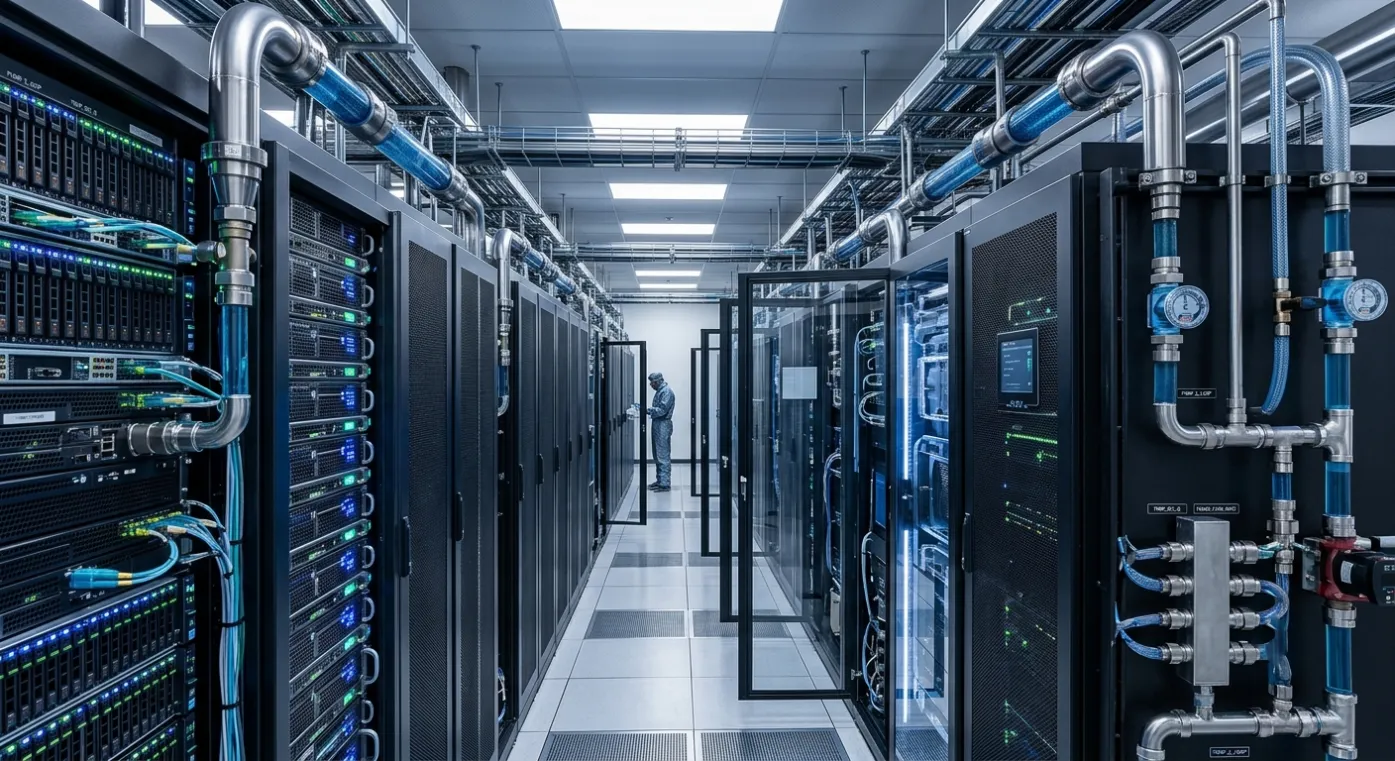
Artificial intelligence has been framed almost entirely as an energy story. Headlines track electricity demand, grid strain and the carbon footprint of training ever-larger models. Water has stayed in the background, despite being just as central to how these systems run. Every large language model query, every training cycle, every hyperscale data centre humming in the background of the AI economy depends on water to keep the hardware cool enough to function. As AI adoption accelerates, that dependency is becoming one of the more consequential and least discussed costs of the boom.
The scale of AI’s water footprint
The numbers involved are difficult to picture at a glance. A United Nations University report published in mid-2026 projected that AI-related water consumption could reach 9.3 trillion litres by 2030, enough to meet the basic domestic water needs of over a billion people for a year. In 2025 alone, global data centres were estimated to have consumed enough water to fill 1.8 million Olympic-sized swimming pools.
Hyperscale operators are beginning to disclose figures that back up these projections. Google’s 2026 environmental report recorded 10.9 billion gallons of water consumption, while Amazon disclosed 2.5 billion gallons globally for 2025, its first public figure of this kind. In the United States, data centre water consumption tied to AI infrastructure was reported to be nearing one trillion litres a year, with Texas facilities alone drawing more than 50 billion gallons in 2024, enough to supply a city the size of Austin for several months.
These figures capture direct water use for cooling. They do not include the indirect water consumed generating the electricity that powers these facilities, much of which still comes from thermoelectric power plants that themselves rely on water for cooling. Nor do they capture the water embedded in chip manufacturing. The full footprint of AI is considerably larger than cooling tower withdrawals alone suggest.
Why water is becoming the binding constraint
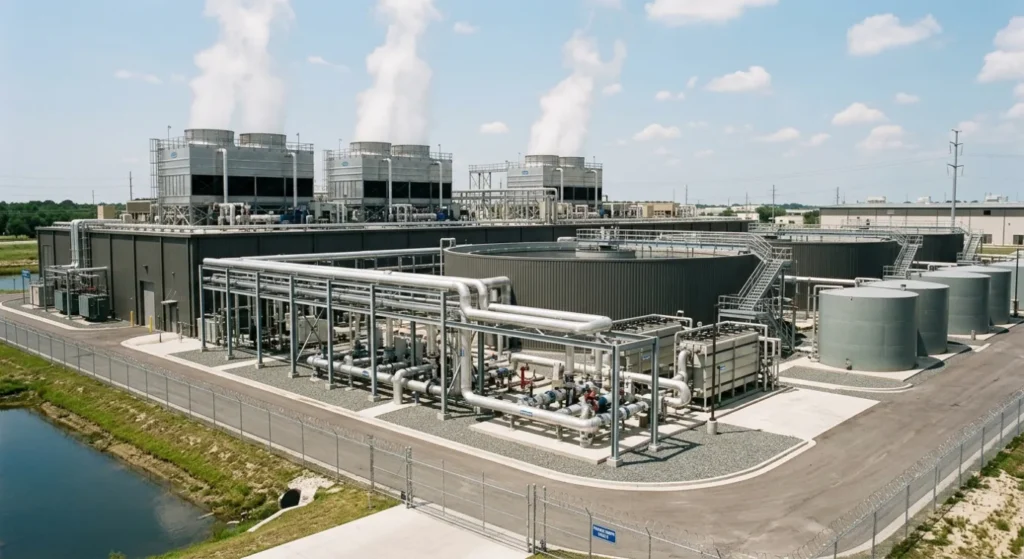
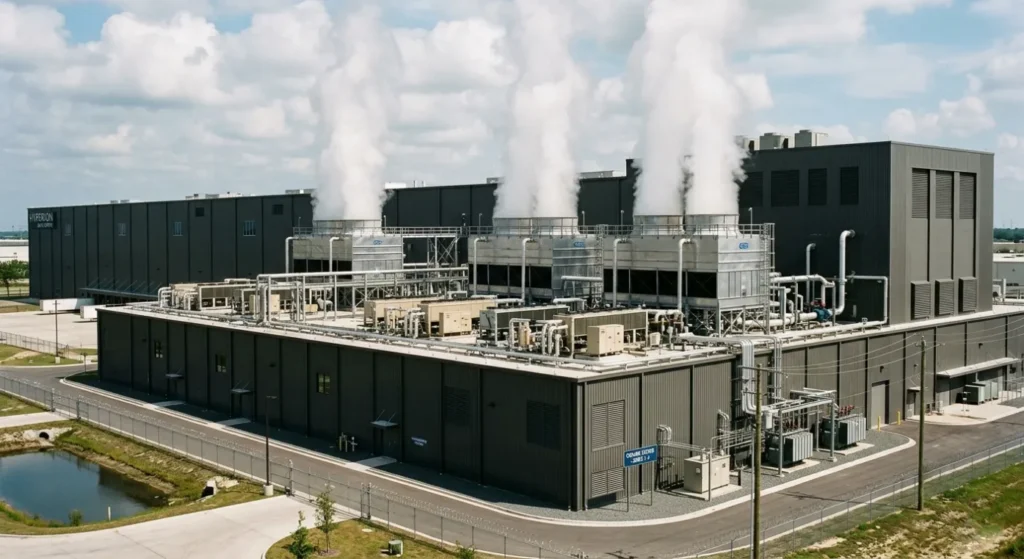
Electricity has dominated the AI infrastructure conversation because grid capacity is visible and politically charged. Water is a quieter constraint, but in many respects a harder one to manage. Traditional evaporative cooling systems, still the default for a large share of existing data centre capacity, lose water permanently to the atmosphere rather than recirculating it. Roughly four-fifths of the water withdrawn by these systems evaporates outright.
The engineering challenge is compounded by how uneven demand actually is. Annual averages understate the pressure that individual facilities place on local water systems during peak conditions. Research from UC Riverside and Caltech found that daily water demand from evaporative cooling can run six to ten times higher than the annual average during hot weather, and more than thirty times higher for some newer facilities. A single large hyperscale campus can draw upwards of five million gallons on a hot day, comparable to the daily needs of a town of tens of thousands of people. Meeting that kind of peak demand without straining local infrastructure is estimated to require between ten and fifty-eight billion dollars in new water system investment across the United States by 2030, a cost that tends to land on local ratepayers rather than the operators driving the demand.
Much of this new capacity is also being sited in places least equipped to absorb it. Arizona, Texas and other drought-prone regions have become preferred locations for new AI infrastructure, largely because of land availability, energy access and favourable tax arrangements. Those same regions are already managing chronic water stress, which puts data centre expansion on a collision course with agricultural, municipal and industrial users competing for the same limited supply.
Which industries are exposed, and how
Data centre operators sit at the centre of this issue, but the exposure extends well beyond them. Any business that has built its operations around cloud infrastructure or AI-powered tools is, whether it recognises it or not, drawing on the same water-constrained systems.
Sectors with significant environmental, social and governance commitments are the first to feel the pressure directly. Financial services firms, healthcare providers and professional services businesses that have committed to net-zero or water stewardship targets increasingly need to account for the water footprint of their AI vendors, not only their own operations. A supply chain audit that stops at carbon emissions no longer tells the full story.
Manufacturers and heavy industry located near major data centre campuses face a more immediate and practical problem: competition for regional water allocations. In water-stressed basins, a new hyperscale facility can shift the calculus for every other permit holder drawing from the same source, from irrigation districts to industrial plants that have operated in the area for decades.
Technology and SaaS companies that resell or build on top of hyperscaler infrastructure are exposed through reputational and regulatory risk rather than direct consumption. As disclosure frameworks mature, following the UN-endorsed reporting model and the growing number of state-level rules in the US, businesses further down the AI supply chain are likely to face increasing pressure to understand and report on the water intensity of the infrastructure they depend on.
The cooling technology shift already underway
The industry’s response has moved faster than public awareness of the problem. Closed-loop cooling systems, which recirculate the same water continuously rather than losing it to evaporation, are becoming the default architecture for new AI-specific facilities rather than a specialised alternative. Some operators are reporting water recycling rates above ninety percent using these designs.
Hardware is changing in parallel. Newer GPU generations, including NVIDIA’s Vera Rubin racks announced in early 2026, are engineered to run safely with higher-temperature water, reducing or removing the need for energy- and water-intensive chillers altogether. Direct-to-chip liquid cooling and immersion cooling are also gaining ground, cutting reliance on evaporative towers by moving heat away from components more efficiently.
Reclaimed and non-potable water is increasingly being substituted for freshwater withdrawals, though this varies significantly by jurisdiction. Oregon permits recycled water for industrial cooling under a project-by-project review process, while Arizona’s reclaimed-water rules specifically prohibit direct reuse for evaporative cooling and misting. This regulatory patchwork is becoming a genuine factor in where new capacity gets built, alongside energy pricing and grid access.
Water Usage Effectiveness, or WUE, is emerging as a metric operators track with the same seriousness as Power Usage Effectiveness. That shift signals that water is no longer treated as an operational afterthought but as a design constraint from the outset.
Where industrial water treatment expertise fits in
Meeting these targets is not simply a matter of switching to a closed-loop system. Recirculated and reclaimed water introduces its own engineering challenges: dissolved solids concentrate over time, scaling and corrosion risks increase, and biological growth needs to be controlled to protect equipment designed to run for years without a full flush. This is where specialist industrial water treatment expertise becomes essential rather than optional.
ABCO Water, an Australian industrial water treatment provider with a strong background in remote and arid environments, points to cooling tower blowdown recycling as one of the more immediately impactful interventions available to data centre operators. Treating blowdown water to remove sparingly soluble salts allows the remaining stream to be safely recirculated at high recovery rates, turning what was previously a waste stream into an internal resource. For operators working in water-stressed basins, this kind of high-recovery treatment can be the difference between a facility that competes with the surrounding community for supply and one that operates largely independently of it.
Experience gained treating water in remote and arid conditions translates directly to the challenges facing AI infrastructure sited in places like the American Southwest. Both contexts demand systems that can maintain water quality with minimal external input, cope with variable feed water chemistry, and keep operating reliably where support infrastructure is thin. ABCO’s view is that operators who treat water reuse as a core design principle from the earliest planning stages, rather than a retrofit once local pushback or regulatory pressure arrives, are the ones best positioned to scale sustainably as water becomes a defining constraint on AI growth.
What water-intensive industries should do now
For businesses in sectors that depend on water-intensive infrastructure, whether directly as data centre operators or indirectly as heavy users of AI and cloud services, the practical response starts with visibility. Understanding the water footprint of the infrastructure a business relies on, not just its energy use or carbon output, is becoming a basic requirement for credible sustainability reporting.
Engaging water treatment expertise early in site selection and infrastructure planning tends to produce better outcomes than retrofitting systems after regulatory or community pressure builds. The economics increasingly favour this approach in any case: treatment systems that recover a high share of cooling water for reuse can pay for themselves within several years through reduced water purchase costs and avoided discharge fees, quite apart from the reputational benefit of operating with a smaller footprint in a water-stressed region.
The regulatory environment is also moving quickly enough that businesses cannot assume today’s rules will hold. State-level frameworks for recycled water use are still being written in many jurisdictions, and the direction of travel, driven partly by the UN’s disclosure framework, points towards more mandatory reporting rather than less. Industries built around water-intensive technology have an opportunity to get ahead of that shift by treating water stewardship as a core part of infrastructure planning now, rather than a compliance obligation to address later.

Lucy Holmes is a tech writer here at Optimax, where she works closely with our design and development team to turn technical website topics into clear, useful content for business owners. With a background in Information Technology (Web Systems) from RMIT University and several years of agency experience, Lucy writes about website performance, UX best practices, SEO fundamentals, and practical ways AI is being used in modern web projects. She also spends time testing new AI tools, keeping across accessibility standards, and building small side projects to trial new frameworks. When she is not writing, she is usually out hiking or taking photos, often well away from decent mobile reception.